Experience Analytics not working

June 09, 2019 ·

Experience Analytics not working

Hello Sitecorian,

How many of you have encountered an error or the situation where graph on the experience analytics dashboard or graph on launchpad's dashboard is not working

I recently encountered with this scenario where i was presented with the situation where simply graph was not coming up, Before digging completely into it and checking logs and everything, From very first high level thoughts pointed me to check

  • Is the valid certificate is used for xconnect?
  • Are thumbprints are correct in all configs? We had scaled environment so i needed to check the thumbprint in all the needed roles.
  • Is xconnect site is accessible from CD? Without any https exceptions?
  • Is XDB is enable? 
  • Is Tracking is enable? 
Everything looked ok on first place, so i finally took my sleeves up and started digging into details, Below are the details steps and exceptions those were captured and i will also show you the topology of instances we were using.

Scaled instance

We are using Sitecore 9.0.2 XP1 installation so we had CM and CD two physical servers, and on CM we had all roles installed with different web site in IIS, so basically all roles are working separately.

Now it was time to start to do some initial check, in most 99% cases it is certificate issue or certificate thumbprint issue so i quickly did following

1) Checked xconnect certificate on CM and CD and also double checked the thumbprint used 
You can find Here The detail steps how to see correct certificate and correct thumbprint of that certificate and make sure the same thumbprint is used in all the roles, In our case everything was good, right thumbprint was used in all roles, all had correct thumbprint of xconnect certificate.

2) Checked by visiting the xconnect site URL from CD and CM
To make sure that visits are registered, first step is to check if the xconnect site is accessible from CD instance and it was being accessible in our case, right certificate was used and correct site was being resolved.

3) Very initial steps after sitecore installation is to "Deploy marketing definitions" and "Rebuild link database"
It is must to deploy marketing definitions after configuring the scaled instance, as shown below in the image taken from Sitecore Documentation 
This steps was performed, i restarted IIS and visited the CD site but still there was no graph.
4) Double check the connection string on all roles.
Just to make sure that all roles are having right connection strings and having proper username and password, and right certificate thumbprint.
 5) Check the log of XConnect Instance, CM server Processing instance and Reporting instance
On checking the xconnect log i came across below exception

System.UnauthorizedAccessException: Access to the registry key 'Global' is denied


To fix this exception, we will need to add app pool user to the following groups

Performance Monitor Users
Performance Log Users

to do that, go to Computer Management and go to following path


Now double click both of this and add xconnect app pool use to this group, restart IIS and check the log again, GOOD, the error was gone

NOTE: Make sure to see whichever role is having this exception, add them to this group.

6) Message: Login failed for user 'poolsuser' in processing role instance log.
Because processing does the processing for collected data and processes it, this exception also gave me the clue that something is wrong, and i checked in the database and found out that in connection string for processing this user was used.

So i checked the DB and processing database and found out that this user did not exist for some reason, so created user and gave it proper access rights, restarted the processing instance and this error was gone, and now processing user was able to connect to DB.

7) Dimension could not be resolved for for dimension id: {GUID}
Looking further, when connection strings were checked and all instance were able to connect to DB , i started getting

10472 07:59:51 ERROR [Experience Analytics]: SegmentProcessor failed to process interaction 'fde57c16-f6a0-0000-0000-058df2ab65f2' segment '2985ad79-b475-494d-a3e0-df2573e66f04' - System.InvalidOperationException: Dimension could not be resolved for for dimension id: fa282c5b-a373-4b89-9977-18a8498ee53e
   at Sitecore.ExperienceAnalytics.Aggregation.Data.Model.AggregationSegment.get_Dimension()
   at Sitecore.ExperienceAnalytics.Aggregation.Data.Model.AggregationSegment.GetData(IVisitAggregationContext context)
   at Sitecore.ExperienceAnalytics.Aggregation.Pipeline.SegmentProcessor.ProcessSegments(IInteractionAggregationContext context, IEnumerable`1 segments)
10472 07:59:51 ERROR Aggregation Error
Exception: System.InvalidOperationException
Message: Dimension could not be resolved for for dimension id: fa282c5b-a373-4b89-9977-18a8498ee53e
Source: Sitecore.ExperienceAnalytics.Aggregation
   at Sitecore.ExperienceAnalytics.Aggregation.Pipeline.SegmentProcessor.ProcessSegments(IInteractionAggregationContext context, IEnumerable`1 segments)
   at Sitecore.ExperienceAnalytics.Aggregation.Pipeline.InteractionProcessor.AggregateSegments(IInteractionAggregationContext context, AggregationScope scope)
   at Sitecore.Analytics.Aggregation.Pipeline.InteractionAggregationPipelineProcessor.Process(InteractionAggregationPipelineArgs args) 

I tried to search this in sitecore and found out that, Dimensions did exist on following path

"/sitecore/system/Marketing Control Panel/Experience Analytics/Dimensions/Connect/By contact orders"

We found out that this dimension belongs to Sitecore Commerce and processing instance also need this dimension and not only CM instance

So We went to Sitecore Commerce installation package and found out the folder "Sitecore Commerce ExperienceAnalytics Core 11.2.83.zip" and manually copied DLLs and Configs to processing server's bin and App_Config

Restarted the IIS but no luck, because one final step was missing

8) Rebuild Reporting DB
I tried to look into the table and found out that interaction table was actually having interactions, so only thing was that they were not being aggregated and processed to show the report somehow.

So It was time to Rebuild Reporting DB, Restarted IIS.


And.......Hurrreeeeyyyy the graph was back and started registering the hits, Phew...huge relief.

I had some close interaction with few of my colleague which really helped me understand the flow of information and xconnect troubleshooting

Kiran Patil
Mahek Chaniyara
Sreekrishnan

NOTE: After having this analytics issue, I found out that in most of the cases related to experience analytics and xconnect issue, Following are the most frequent reasons

1) Xconnect certificate and its thumbprint issue
2) Marketing definitions not deployed (Dimensions and Interaction will not be found otherwise)
3) Reporting DB is not rebuild

I hope above steps will help someone troubleshoot the issue related to similar situation


Xconnect certificate thumbprint and communication with sitecore and xconnect

June 09, 2019 ·

Xconnect certificate thumbprint and communication with sitecore and xconnect

Hello People,

One of my blog post i was writing about the issue i had with my xconnect and experience analytics not working

On the same line i had to troubleshoot and check xconnect certificate and thumbprint in config files, So i also discovered in this process that lot of people like me did not have exact idea about how xconnect and sitecore communicates and what is thumbprint and why it is used and where it is configured, So thought to do a quick blog post about it.

Communication between Sitecore and Xconnect
Everyone of us will need to work with xconnect directly or indirectly, so its better to understand how sitecore talks to xconnect.


xconnect (Definition)
xConnect is the service layer that sits in between the xDB and any trusted client, device, or interface that wants to read, write, or search xDB data. Communication must happen over HTTPS and clients must have the appropriate certificate thumbprint

Now my point of interest here is to tell you is how Sitecore and xconnect connects and what is the  thumbprint for it and where it is configured.

So xconnect is the server where client connects, so here in our case sitecore is the client which connect to xconnect for its services like analytics and marketing automation features and services which are abstracted in xconnect.

Why xconnect certificate is used
It provides additional layer of scurity and It is considered secure than traditional user name and password to communicate and it is cryptographically secure way to have a communication between Sitecore & Xconnect.

Now if we observe the xconnect AppSettings.config file of xconnect role


  • AllowInvalidClientCertificates 
         This defines if the Sitecore is allowed to connect even if the certificate is invalid, So this is also   interesting to know that if you still want to connect if you do not have trusted client certificate, you can still use that certificate but you just need to keep the value of AllowInvalidClientCertificates =true. (though not recommended for production)


  • ValidateCertificateThumbprint
         This is thumbprint of the xconnect certificate, and this setting defines that what other roles should have which thumbprint, you can verify this thumbprint with the certificate thumbprint to make sure that which certificate is being used to communicate.


As shown above, i have opened the xconnect certificate and see the thumbprint, so we can make sure that this is the certificate and the thumbprint should be used in all roles (if scaled environment)

  • Thumbprint needed in what roles in scaled environments 
In our case we had CM server and CD server, and on CM server we had different roles installed on same CM server with different IIS instance of those role configured, So go to Connectionstring.config and AppSettings.config of all roles like Processing, Reporting, Xconnect Search, Content Managemnet, Content Delivery and verify the thumbprint with xconnect thumbprint and make sure that those are same as xconnect certificate thumbprint.


So, hope above information helps to understand why xconnect is needed, where to find thumbprint, what if we do not have trusted certificate and what all roles will need the same thumbprint to connect with xconnect.


February 07, 2019 ·

Configure https on existing solr running on http

Hello All,

I had the scenario today where i installed my solr nodes and services and everything was working fine, but later i noticed that we will need solr running on https with sitecore 9.1, and i saw on the internet that how we can generate the certificate and put it in the trusted certificate store and update solr.in.cmd file so that it has all those entries to make solr run as https and also we will need solr certificate .pfx file on the path $solr\server\etc folder.

I also got some scripts on the internet and i tried them out but there was something missing and my solr did not start with https somehow.

So what i did was i took my solr installation powershell script which installed solr from the scratch, installs certificate and configures it, also restarts services etc.

So i took that script and modified in a way so that it only does things for making existing installed solr from http to https.

Following is the script

Param(
    $solrVersion = "6.6.2",
    $installFolder = "C:\Daivagna", ##Path to your solr folder, where your solr foler i.1 solr6.6.2 is copied, in my case it is inside c:\daivagna
    $solrPort = "8787",
    $solrHost = "solr",
    $solrInstanceName ="testsolrservice"
)
$solrName = "solr-$solrVersion"
$solrRoot = "$installFolder\$solrName"

## Verify elevated
## https://superuser.com/questions/749243/detect-if-powershell-is-running-as-administrator
$elevated = [bool](([System.Security.Principal.WindowsIdentity]::GetCurrent()).groups -match "S-1-5-32-544")
if($elevated -eq $false)
{
    throw "In order to install run solr as https please run as administrator."
}

# Generate SSL cert
$existingCert = Get-ChildItem Cert:\LocalMachine\Root | where FriendlyName -eq "$solrName"
if(!($existingCert))
{
 Write-Host "Creating & trusting an new SSL Cert for $solrHost"

 # Generate a cert
 # https://docs.microsoft.com/en-us/powershell/module/pkiclient/new-selfsignedcertificate?view=win10-ps
 $cert = New-SelfSignedCertificate -FriendlyName "$solrName" -DnsName "$solrHost" -CertStoreLocation "cert:\LocalMachine" -NotAfter (Get-Date).AddYears(10)

 # Trust the cert
 # https://stackoverflow.com/questions/8815145/how-to-trust-a-certificate-in-windows-powershell
 $store = New-Object System.Security.Cryptography.X509Certificates.X509Store "Root","LocalMachine"
 $store.Open("ReadWrite")
 $store.Add($cert)
 $store.Close()

 # remove the untrusted copy of the cert
 $cert | Remove-Item
}

# export the cert to pfx using solr's default password
if(!(Test-Path -Path "$solrRoot\server\etc\solr-ssl.keystore.pfx"))
{
 Write-Host "Exporting cert for Solr to use"

 $cert = Get-ChildItem Cert:\LocalMachine\Root | where FriendlyName -eq "$solrName"

 $certStore = "$solrRoot\server\etc\solr-ssl.keystore.pfx"
 $certPwd = ConvertTo-SecureString -String "secret" -Force -AsPlainText
 $cert | Export-PfxCertificate -FilePath $certStore -Password $certpwd | Out-Null
}
else
{
 Write-Host "Old certificate already found on the path = $solrRoot\server\etc"
}
# Update solr cfg to use keystore & right host name
if(!(Test-Path -Path "$solrRoot\bin\solr.in.cmd.old"))
{
 Write-Host "Rewriting solr config"

 $cfg = Get-Content "$solrRoot\bin\solr.in.cmd"
 Rename-Item "$solrRoot\bin\solr.in.cmd" "$solrRoot\bin\solr.in.cmd.old"
 $newCfg = $cfg | % { $_ -replace "REM set SOLR_SSL_KEY_STORE=etc/solr-ssl.keystore.jks", "set SOLR_SSL_KEY_STORE=$certStore" }
 $newCfg = $newCfg | % { $_ -replace "REM set SOLR_SSL_KEY_STORE_PASSWORD=secret", "set SOLR_SSL_KEY_STORE_PASSWORD=secret" }
 $newCfg = $newCfg | % { $_ -replace "REM set SOLR_SSL_TRUST_STORE=etc/solr-ssl.keystore.jks", "set SOLR_SSL_TRUST_STORE=$certStore" }
 $newCfg = $newCfg | % { $_ -replace "REM set SOLR_SSL_TRUST_STORE_PASSWORD=secret", "set SOLR_SSL_TRUST_STORE_PASSWORD=secret" }
 $newCfg = $newCfg | % { $_ -replace "REM set SOLR_HOST=192.168.1.1", "set SOLR_HOST=$solrHost" }
 $newCfg | Set-Content "$solrRoot\bin\solr.in.cmd"
}
else
{
 Write-Host "File already exists on the path $solrRoot\bin\solr.in.cmd.old"
}   


# install the service & runs
$svc = Get-Service "$solrInstanceName" -ErrorAction SilentlyContinue
if(!($svc))
{
    Write-Host "Installing Solr service"
    &"$installFolder\nssm-$nssmVersion\win64\nssm.exe" install "$solrInstanceName" "$solrRoot\bin\solr.cmd" "-f" "-p $solrPort"
 &"$installFolder\nssm-$nssmVersion\win64\nssm.exe" set "$solrInstanceName" "Description" "$solrPort"
    $svc = Get-Service "$solrInstanceName" -ErrorAction SilentlyContinue
}
if($svc.Status -ne "Running")
{
    Write-Host "Starting Solr service"
    Start-Service "$solrInstanceName"
}
else
{
 Write-Host "Re-Starting Solr service"
    Restart-Service "$solrInstanceName"
}

# finally prove it's all working
Invoke-Expression "start https://$($solrHost):$solrPort/solr/#/"


What is does is simply creates certificate for existing solr running on specified port, installs it on a machine and copies it to etc folder of the $solr\server\etc, and edit its solr.in.cmd file with generated certificate and restarts or starts service.
Now, I am using the same script to make any non https solr to https. Cheers !!!
"Find All Reference" like functionality for sitecore content tree

January 16, 2019 ·

"Find All Reference" like functionality for sitecore content tree

Problem
I was new to Sitecore and I had to trace lot of things on the existing project to find out where all the elements are connected, like these renderings are used where? which item is using which template or if you have a template, which item is being created from that template, all those references I was trying to find.


Being a .net guy and visual studio familiar, you always love to see if you can get something like "Find all references" and can find where the object you are refereeing to is referenced.


Solution
Sitecore provides real good referencing in its "Navigate->Links" menu, You select any object be it, layout, rendering, template and go to Navigate menu
and inside it click "Links" menu it will give you following two types of reference

  • Items that refer to the selected item.
  • Items that selected item refers to.

It becomes easy when you are having some experience in Sitecore, but if you are just new to Sitecore, this will definitely help !!!

How to see logs on azure pass apps

November 27, 2018 ·

How to see logs on azure pass apps

Hello People,


Problem

Is it only me or you also faced the issue where you uploaded your app on azure web app and you wanted to troubleshoot why it is not working? And like everyone, I was missing the folder structure views where i can go and see my log files which i have written c# code on my methods.

What i had in my catch block was below

Trace.TraceError("Error = " + ex.Message);

Now on azure web app, everything was deployed and i wanted to see where it is breaking so following is the path where you can see it

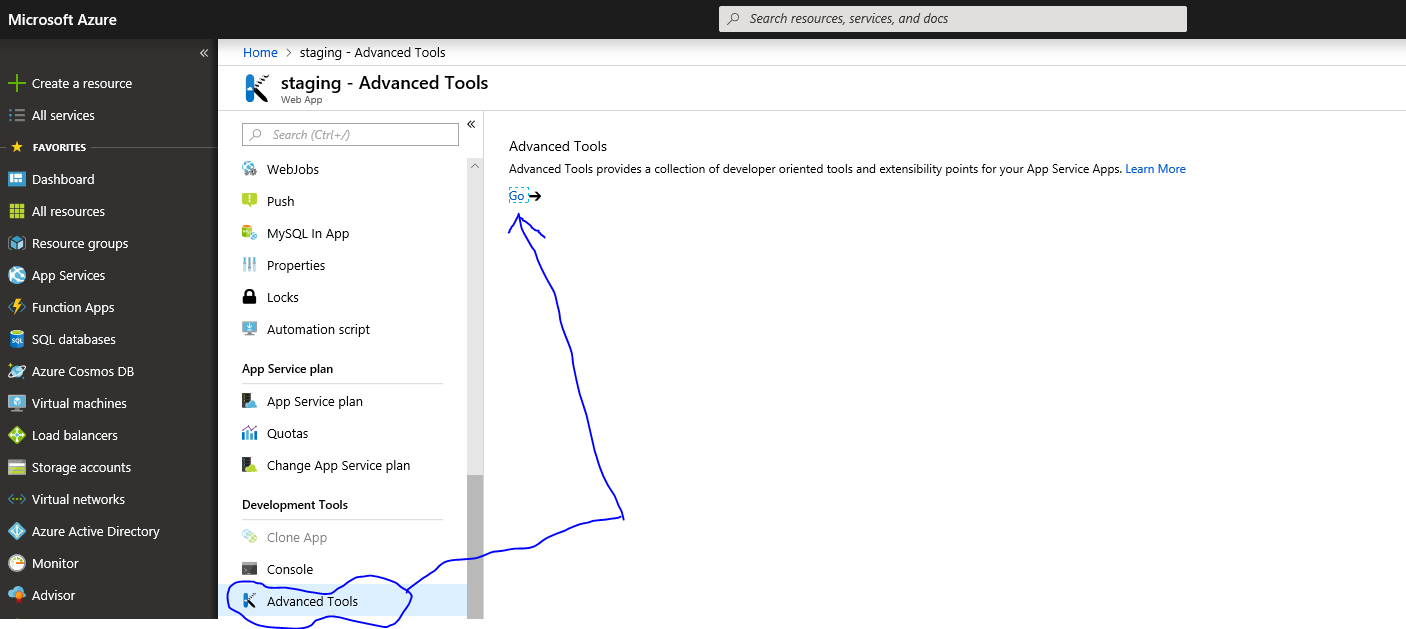
  • Login into your azure portal
  • Go to your web app and you will find below option
  • After clicking GO, you will be taken to Kudu UI, Click on Debug Console menu and select CMD
  • This will take you to the folder structure and you can go to your LogFiles folder using standard console command and will be able to download the log files


Hope it helps !!!

November 01, 2018 ·

One or more exceptions occurred while processing the subscribers to the 'item:creating' event

I was recently installing the packages from one of the QA environment to my local Sitecore instance, "Media library package" to be precise, And it started giving me this below error

One or more exceptions occurred while processing the subscribers to the 'item:creating' event

Looking at the sitecore logs, it gave me more info on the context and the actual inner exception was following
Solution: 'Name' should consist only of letters, digits, dashes or underscore

Now it was evident that some of my file names were violating the naming rule, I could see in the log just before exception from where the installer stopped creating items, and that file name had round braces "(" and ")" at the end of it, with my surprise I was able to create the item with those name in the content tree, but below was the solution for it,

Solution

I am using SC 9.0.1 and in that Go to Sitecore.Marketing.config file residing in 
"App_Config\Sitecore\Marketing.Operations.xMgmt" folder and find two entries as below
<event name="item:saving"> <handler type="Sitecore.Marketing.xMgmt.Definitions.ItemEventHandler, Sitecore.Marketing.xMgmt"
method="OnItemSaving"/> </event> <event name="item:creating"> <handler type="Sitecore.Marketing.xMgmt.Definitions.ItemEventHandler, Sitecore.Marketing.xMgmt"
method="OnItemCreating"/> </event>

Comment them out and try to import the package again, this time it will work, Once you are done restoring the package, You can revert that file back by uncommenting those entries.


Hope it helps !!!

Integrate Sitecore With OPENSOLR

October 29, 2018 ·

Integrate Sitecore With OPENSOLR


Here goes the story...
Personally when I looked up on the internet I did not find lot of documents which could tell how you can integrate Sitecore with OPENSOLR cloud provider, So I did hands on to it, Talked to their support and successfully integrated our sitecore to create indexes in cloud, Following are the highlights and troubleshooting points that I faced and how you can avoid it.
Quick "How-to" integration points

  • Register on https://opensolr.com/users/login
  • From Dashboard hover over "My Indexes" and select "Add New"

  • Select GEO location server where you want to put index

  • One important thing here is, OPENSOLR does not allow indexes with default keyword "sitecore_", so you will not be able to create those indexes, but to create them, you will need to use following configuration in those config files

  • <index id="sitecore_master_index" type="Sitecore.ContentSearch.SolrProvider.SolrSearchIndex, 
    Sitecore.ContentSearch.SolrProvider">
                <param desc="name">$(id)</param>
               <param desc="core">mysitecore_master_index</param>
    

  • I have shown the content of Sitecore_ContentSearch_Solr_Index_Master.config file and as you can see my index name is same but I have provided the "CORE" name so that it does not contain "sitecore_" keyword, You will need to use this name to create indexes in OPENSOLR.
  • On prompt of create index supply index name, NOTE: If you have specified CORE in search index config, name you give here must match with the CORE name of index and if no CORE is specified in search config, It should match with the index name, Default Sitecore index config will have CORE specified and custom indexes might not.
  • Click on "gear icon (settings icon)" on created index to go to index settings page
  • Click "UPLOAD CONFIG FILES" tab
  • Upload SCHEMA.zip first and after that upload SolrSchema.zip NOTE: Here we need to ask support to provide these files and upload order must match.
  • Do step 2-7 for all other indexes
  • Change ContentSearch.Solr.ServiceBaseAddress URL value in Sitecore.ContentSearch.Solr.DefaultConfiguration.config file pointing to the OPEN SOLR cloud URL (you can get that URL by clicking "Admin Panel" button on each of INDEXes settings page (Step-5)

  • Restart IIS and Open sitecoreintsance/Sitecore
  • From Sitecore launchpad->Control panel->Populate Solr Managed Schema
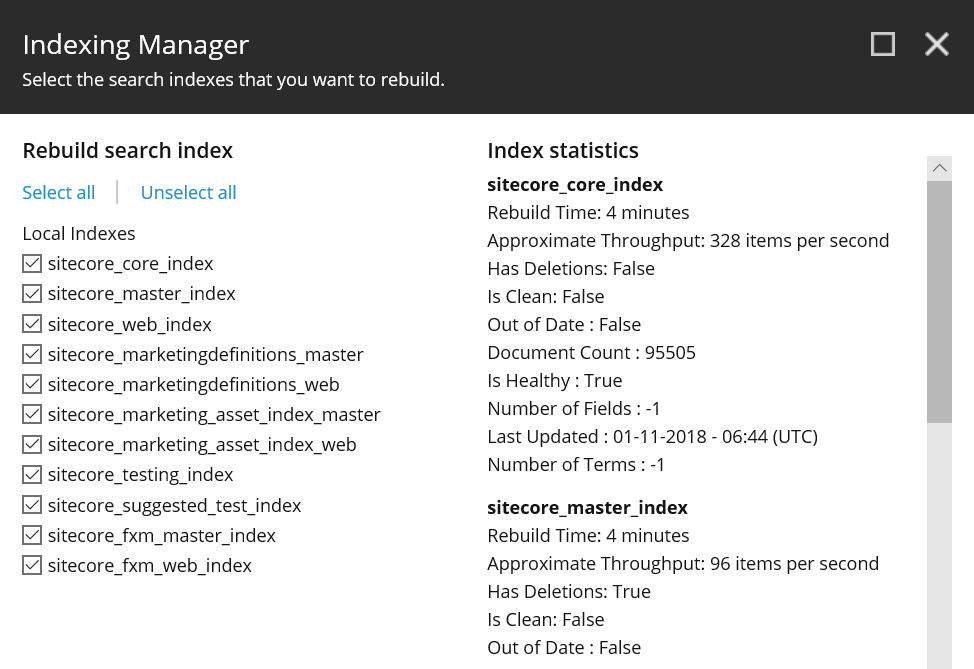
  • Rebuid index from Sitecore launchpad->Control panel->Indexing manager
  • If everything goes well and if you are able to generate schema and rebuild indexes, you can verify the same by going into "Admin Panel" of any index settings and you can see your SOLR user interface and observe that new documents are created as it will show document count.

Major errors and issues
Personally I faced two major issues,
  • Getting 400 bad requests with different field errors, like unknown field_indexName or unknown field "version_im" or Document is missing mandatory uniquekey field: id
  • Managed-schema.xml of my current on-prem sitecore "conf" did not work at all, which is the known issue in SOLR and Sitecore, Refer to the url https://kb.sitecore.net/articles/227897

Solution
  • Very first thing is you need to make sure is that your SOLR schema, contents of the "conf" folders are corrected, you will need to make sure that there are no "managed-schema.xml" file but rename it to "schema.xml" file, From SOLR 6+, There are no schema.xml files available but only Managed-Schema.xml is there, but that needs to be renamed.
  • Make sure you are referring to correct "conf" of SOLR version, My life saver was OPENSOLR support guy, He provided me two files Schema.xml and SolrSchema.xml (zip files), and uploading those files to my index configuration worked like a charm, So you may want to contact OPENSOLR chat support or via email to talk about this issues, They will see the logs on their end to find out what is the actual issue.
  • Make sure upload order of those two files are followed, first upload schema.xml and later on upload SolrSchema.xml (zip)

I hope this would be helpful for people to get started and integrate with OPENSOLR, Cheers !!!

September 23, 2018 ·

Sitecore 9 : Error in controller rendering throws Error rendering controller:the current route url is: '{*pathinfo}'. this is the default sitecore route which is set up in the 'initializeroutes' processor of the 'initialize' pipeline sitecore 9

Hello Guyz,
Believe me but I just had the nightmarish situation where I got trapped in this controller rendering issue where it kept on giving me below error

Error rendering controller: the current route url is: '{*pathinfo}'. this is the default Sitecore route which is set up in the 'initializeroutes' processor of the 'initialize' pipeline 

There mainly two reasons for this exception

  • Controller rendering you have used is having either wrong namespace, wrong controller name or wrong assembly name.
  • There is something wrong with System.Web.Mvc.dll

you should first observe your controller rendering configuration, see if namespace or controller name or assembly name are correctly given? this is common issue when we copy and paste the path and it could contain spaces or aeesmbly name could be wrong, if everything looks good there, read further

I tried everything like changing the name of controller, deleting the physical controller and creating It with different name, deleting renderings from sitecore and try creating them again, deleting global.asax file deleting sitecore cache, but I was ending in the same error all the time, and finally one fine moment I was out side my home one small thing clicked me and I run back to my laptop and tried implementing it and it worked !! Phew !!! which is following .

Solution


Well, When I created my visual studio project it added the System.Web.Mvc.dll by default and it was added with the version 5.2.4.0 which is fine but the issue was that sitecore installation was using the version 5.2.3.0

Now because my general practice is that I delete my projects web.config file and also web..config files from the view, and copy it from sitecore's installation, now my solution had config from sitecore which were pointing to 5.2.3.0 DLL and my solution had 5.2.4.0, which could never work and end up in assembly manifest error, if i deploy, as i did not copied it to BIN that error was not there but somehow solution was using 5.2.4.0 when sitecore requested that page or controller/action path, and due to it the route was not working

A small change i did,

  • Deleted the any old reference from bin folder of my IIS site
  • Copied sitecore's System.Web.Mvc.dll and added it as a reference to my project so i downgraded my project from 5.2.4.0 to 5.2.3.0
  • Deleted web.config and copied it from sitecore's instance
And it worked now sitecore is able to find the route and hitting the MVC controller, Phew !!!

Try above tips if you get trapped in similar situation